Descriptive finite-sample audit · odd-accelerated Collatz
Lightweight prefix audit → reference-coupling reuse audit → waiting-hall bridge alignment
We asked a simple question about Collatz trajectories: if we look only at the first part, do we see any differences in what happens next?
What we found
We looked at how much the numbers rose and fell in the first part. The trajectories then showed some differences in how they moved for a while afterward.
This does not mean that the first part predicted the later motion exactly. Some differences were visible; others remained unclear.
This is not a proof of the Collatz conjecture. We did not test every number, and we did not discover why the pattern occurs. It is an observation within the range of data examined here.
That is the short version. The sections below move step by step through the audit summary, comparisons, numerical results, limitations, and source files.
This report combines three lightweight, reuse-oriented audits. First, among three prefix-local descriptors, cumulative_log_drift was the strongest descriptor across all five finite-future targets examined. Second, a reference-coupling audit tested whether this was merely an artifact of shared reference definitions such as n_t; for future_net_log_change and future_max_log_drawdown, the signal persisted after accounting for the shared reference. Third, the prefix-local axis was compared against a retrospective waiting-hall classification, yielding a partial_prefix_shadow verdict.
This is a descriptive finite-sample audit, not a claim about proof, convergence, or causality.
Safe takeaway
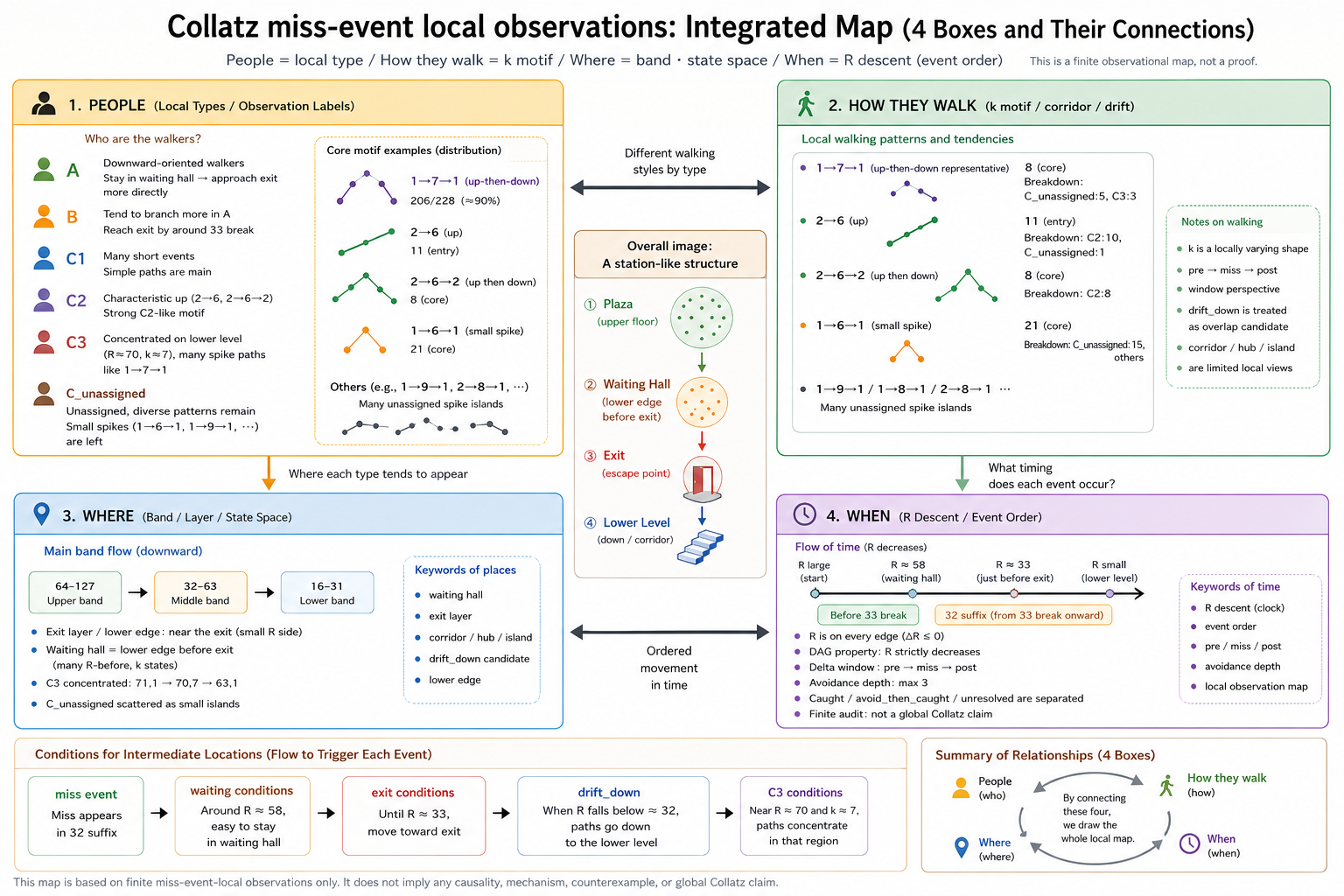
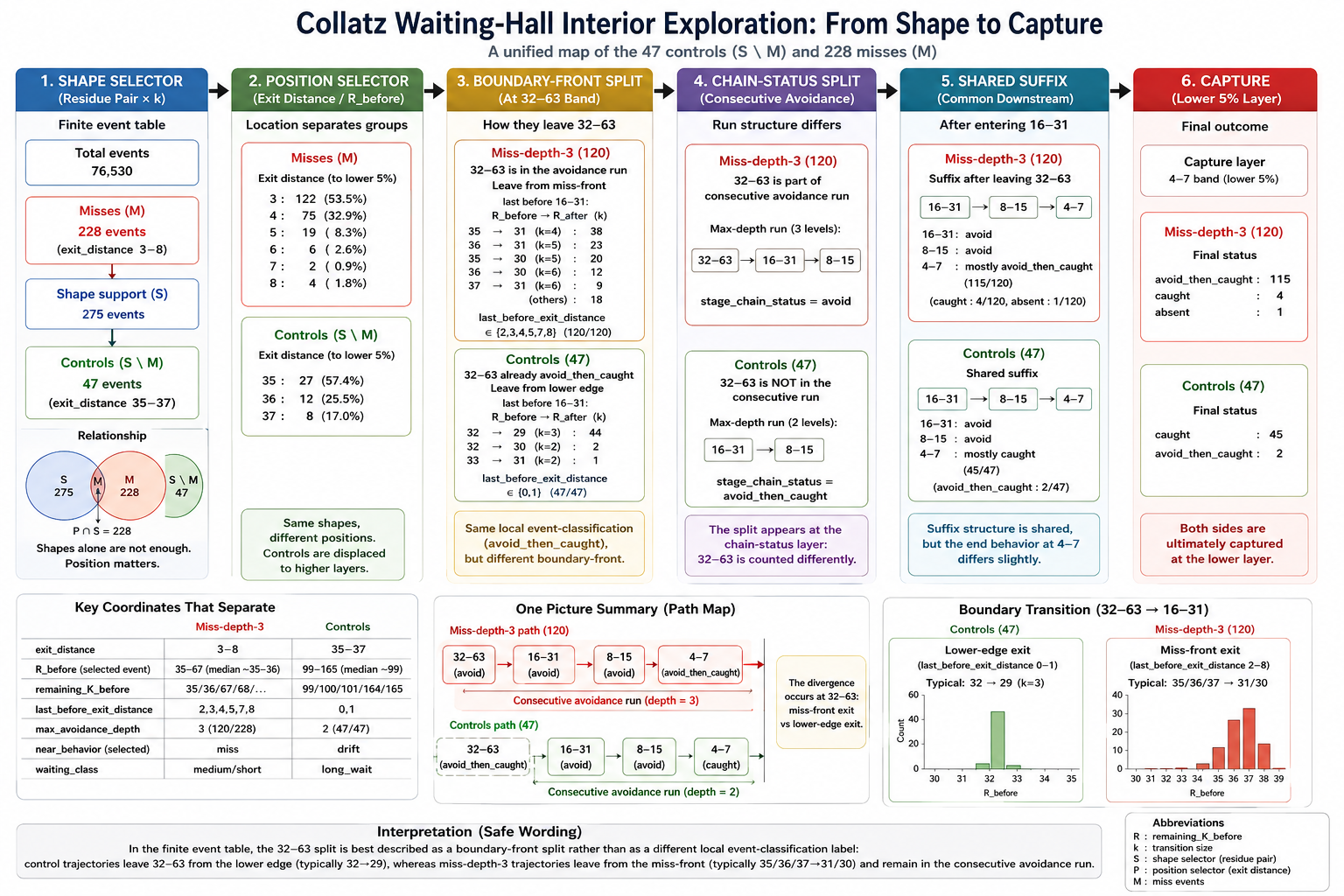
Within the bridge-matched overlap between the waiting-hall archive and the lightweight prefix audit, the drift_down group shows what we call a partial prefix shadow: it has lower values for cumulative_log_drift and future_net_log_change.
This supports a limited connection between the retrospective waiting-hall classification and a prefix-local finite-future signal. It does not extend cleanly to future_max_log_drawdown, and it should not be generalized to the full waiting-hall archive.
| Side | Quantity | Computed from |
|---|---|---|
| Prefix-local axis | cumulative_log_drift, above_start_dwell, record_age |
only n0 … nt — no terminal information |
| Finite-future targets | future_net_log_change, future_max_log_drawdown, future_record_update, future_above_start_dwell, future_drop_below_start |
only the window nt+1 … nt+H |
| Retrospective classification | waiting-hall labels (trajectory_behavior_class, near_behavior, waiting_class, position_label) |
pre-existing waiting-hall archive; not relabeled here |
Horizons are fixed at H = 4, 8, 12, 16, 20, 24, 28, 32, 40, 48, 64, 80, 96, 128 (14 values). Terminal quantities — remaining_K, steps-to-1, total trajectory length, terminal suffix — are never used on the descriptor side. Feature-side leakage flag count: 0.
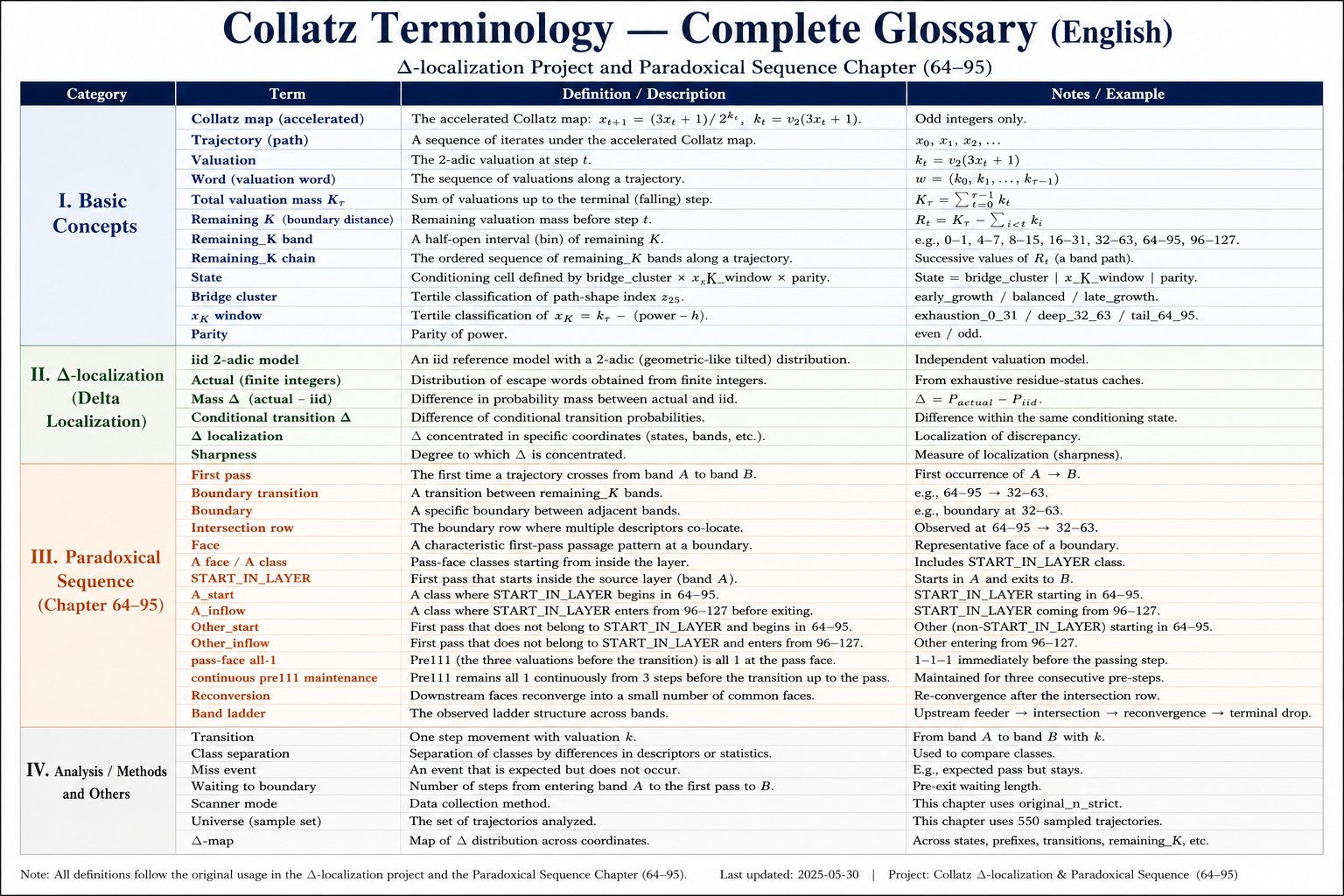
The question is deliberately narrow: does a classification defined retrospectively leave any trace in quantities computable from the observed prefix alone?
| Component | Source or key | Count |
|---|---|---|
| Lightweight prefix audit | seeds 1–10; discovery 5,000 / validation 5,000; 50 bootstrap replicates | 5 targets × 3 descriptors × 14 H |
| Reference-coupling reuse audit | seed 1, same sample; no new sampling | 0 mismatches across 28 comparisons |
| Bridge file rows | exit_neighborhood_per_trajectory.csv | 104,272 |
| Bridge ↔ waiting-hall matched event keys | sample_id + trajectory_id + event_index | 74,116 |
| Overlap with lightweight-audit seed/split sample | bridge-validated keys used for the comparison | 532 |
| Rows after horizon expansion | 532 keys × horizons | 3,382 |
Bridge matching confirmed the waiting-hall table linkage at 74,116 event keys. The prefix-local comparison itself is restricted to the 532-key overlap with the existing lightweight-audit sample, expanded to 3,382 rows across horizons. Every alignment statement below is a statement about that overlap subset only. No new sampling was performed at any stage.
cumulative_log_drift was the best-ranked prefix-local descriptor for every target examined.
| Finite-future target | Best prefix-local descriptor | Stable H | Median validation R² |
|---|---|---|---|
future_above_start_dwell | cumulative_log_drift | 14 / 14 | 0.396 |
future_record_update | cumulative_log_drift | 14 / 14 | 0.369 |
future_max_log_drawdown | cumulative_log_drift | 14 / 14 | 0.205 |
future_net_log_change | cumulative_log_drift | 14 / 14 | 0.162 |
future_drop_below_start | cumulative_log_drift | 11 / 14 | 0.045 |
Direction is consistent: a higher prefix-local drift value goes with a lower future_net_log_change (negative share 0.99) and a larger future_max_log_drawdown (positive share 0.99). future_drop_below_start shows only a weak signal and is not pursued further here.
Both the descriptor and the targets refer to the current value nt. Redefining the targets so that they depend only on future-window values, excluding the current state, left the drift trends essentially intact (absolute trend ratio ≈ 1 at almost every H).
| Descriptor × target family | Future-only attenuation | Persists after state matching |
Non-near-zero residual H |
Outside null |
Final label |
|---|---|---|---|---|---|
cumulative_log_drift × net_log_change |
little 14 / partial 0 / lost 0 | 8 / 14 | 13 / 14 | 10 / 14 | persists_beyond_shared_reference |
cumulative_log_drift × max_log_drawdown |
little 13 / partial 1 / lost 0 | 8 / 14 | 13 / 14 | 11 / 14 | persists_beyond_shared_reference |
above_start_dwell × net / drawdown |
— | 1 / 0 | 12 / 13 | 9 / 9 | unresolved |
record_age × net / drawdown |
— | 0 / 0 | 13 / 13 | 12 / 11 | unresolved |
The shared reference point is therefore not a sufficient explanation on its own for the net-change and drawdown families. The other two descriptors remain unresolved and are not included in the primary interpretation.
| Waiting-hall group | Unique events | Rows (H-exp.) | Mean cumulative_log_drift |
Mean future_net_log_change |
Mean future_max_log_drawdown |
|---|---|---|---|---|---|
drift_down | 490 | 3,029 | −2.72 | −3.17 | 4.37 |
mid_band_wait_then_drop | 30 | 268 | −2.59 | −1.32 | 4.02 |
no_exit_layer_observed | 10 | 63 | 0.02 | −5.64 | 6.55 |
direct_to_exit | 2 | 22 | 0.29 | −1.30 | 2.75 |
| Quantity | drift_down − other | Direction |
|---|---|---|
cumulative_log_drift | −1.963 | prefix-local axis: lower |
future_net_log_change | −0.416 | same direction |
future_max_log_drawdown | −0.071 | unresolved — not consistently aligned |
Verdict: partial_prefix_shadow (fold-wise stable rows for drift_down: 15). The group has a lower mean value on the prefix-local axis and a lower mean finite-future net log change. The drawdown target does not follow consistently, so the verdict is not terminal_consistent_prefix_signal.
cumulative_log_drift works as a prefix-local axis based exclusively on prefix information and is consistently associated with several finite-future targets in this sample.drift_down subgroup is also low on the prefix-local axis, and low in future_net_log_change, indicates that this particular grouping is not solely an artifact of retrospective labeling: some component of it is visible in the observed prefix.drift_down dominates the overlap; direct_to_exit has 2 unique events and no_exit_layer_observed has 10, so contrasts involving those cells are too sparse to support stable inference.record_age and above_start_dwell stay unresolved in the coupling audit.cumulative_log_drift is treated as a baseline descriptor close to standard drift / log-height measures, not as a new theory or newly discovered quantity. Its distinctive use here is as a prefix-local baseline axis for comparing fixed finite-future targets under shared splits.drift_down group, and the two aligned quantities; it is not extended to the full archive or to future_max_log_drawdown.| File | Stage | Contents |
|---|---|---|
future_behavior_target_light_audit_README.md | Lightweight audit | Setup: seeds, bootstrap count, descriptors, targets |
light_target_summary.csv | Lightweight audit | Best prefix-local descriptor and R² per target |
light_observation_target_summary.csv | Lightweight audit | Every descriptor × target pair; stable-H counts, sign shares |
light_full_run_recommendations.csv | Lightweight audit | Coarse priority order for a possible standard run |
reference_coupling_reuse_audit_README.md | Coupling audit | Reuse setup; seed 1; 0 result-diff mismatches |
coupling_attenuation_by_H.csv | Coupling audit | Original vs. future-only trend per H; attenuation labels |
matched_current_state_summary.csv | Coupling audit | Within-current-state-cell trends after matching |
reference_coupling_verdict.csv | Coupling audit | Final label per descriptor × target family |
waiting_hall_bridge_prefix_alignment_README.md | Bridge audit | Bridge key, match counts, verdict |
waiting_hall_bridge_join_manifest.csv | Bridge audit | Source files, join keys, matched row counts |
waiting_hall_bridge_group_alignment.csv | Bridge audit | Group means for every waiting-hall label column |
waiting_hall_bridge_alignment_verdict.csv | Bridge audit | partial_prefix_shadow verdict and group contrasts |
This report used no standard run, added no new targets, did not increase the number of bootstrap replicates, and made no changes to the waiting-hall labels.