00 — SummaryAbstract
We analyze first-pass events across dyadic remaining_K boundaries in 550 accelerated Collatz trajectories under the original-integer, strict same-occurrence mapping. The scan shows an observed band ladder from 96-127 → 64-95 through the 64-95 → 32-63 boundary and into downstream reconvergence. This boundary is notable because several descriptors co-occur there: entry route, local all-1 pass-face context, and first-pass class separation.
Quantitatively, the boundary is not selected by maximal neighbor distance: its summed descriptive distance is 4.676, below the downstream-neighbor average 5.996. The same boundary has class-distance total 15.212; continuous pre111 maintenance is lower than pass-face all-1, with observed shares 0.729 and 0.548. The term A face is used for the first-pass descriptor and distinguished from continuous maintenance and 1111 present at pass. The findings reported here are limited to finite-sample descriptive observations within the present dataset.
01 — Reading guideStance
This note reports a finite, descriptive scan of first-pass events across remaining_K boundaries in accelerated Collatz trajectories. The question asked throughout is where multiple observable descriptors co-occur, not why they do.
Definition boundary. The 550 starting integers are taken from Rozier–Terracol Appendix C as the source list. The operative definitions in this chapter, however, are not the Rozier–Terracol definition on Appendix C occurrences (n, j, q). After selecting those integers, we re-walk them under the original_n_strict same-occurrence scanner and read their first-pass events in the remaining_K coordinate. Thus this chapter is an RT-sourced, scanner-defined remaining_K analysis, not a reproduction of the RT definition itself.
The headline observation, developed in Results: the 64-95 → 32-63 boundary is where an entry-route split, a local all-1 pass-face context, and class separation among four first-pass classes (A_start, A_inflow, Other_start, Other_inflow) co-occur. Boundaries downstream of it mostly reconverge into a small number of compact faces.
No boundary is interpreted as actively sorting trajectories. The term "intersection row" is used for the observed pattern at 64-95 → 32-63. Terms such as "sorting face" or "sorting row" are legacy internal analysis labels; for example, B_sort appears in the source tables but is not used as a scientific claim in this paper.
Low-support cells are flagged and treated as candidate structure, not as load-bearing claims.
02 — Before any resultDefinitions
All quantities below are defined operationally for the 550-trajectory dataset using the original-integer, strict same-occurrence mapping. Throughout this report, this mapping is referred to internally as original_n_strict.
D0. Source list versus chapter definition. Rozier–Terracol Appendix C supplies the finite list of starting integers used here. The chapter does not use the RT finite interval (n, j, q) as its analysis window, and it does not test the RT condition as the chapter definition. Its analysis window is the scanner-generated accelerated valuation word for each selected integer; all remaining_K, boundary, first-pass, entry-route, and A-face quantities below are defined inside that scanner word.
This coordinate records how much valuation mass remains before a given step of the trajectory.
D1. Coordinate. For an odd integer trajectory under the accelerated Collatz map,
x_{t+1} = (3 x_t + 1) / 2^{k_t}, k_t = v_2(3 x_t + 1),with valuation word w = (k_0, k_1, ..., k_{τ-1}) and total valuation mass
K_τ = Σ_{t=0}^{τ-1} k_t. The reported coordinate is the remaining mass before step
t,
R_t = K_τ - Σ_{i<t} k_i.The bins group remaining valuation mass into dyadic ranges used to compare transitions.
D2. remaining_K bins. The bins are half-open dyadic intervals. A transition A → B occurs at position t when R_t ∈ A and R_{t+1} ∈ B. The bins used in this note, narrowest to widest in the active range: 0-1, 4-7, 8-15, 16-31, 32-63, 64-95, 96-127.
This distinction separates events that leave a bin for the target bin from events that remain in the same bin.
D3. pass vs. stay. For a target transition from bin A to bin B, an occurrence starting in A is a pass if its post-step bin is B, and a stay if its post-step bin is still A.
These variables record the valuation at the transition and the local three-step context ending at that transition.
D4. transition_k and pre_k_window_3. transition_k is the valuation step k_t at the transition occurrence; exact tests use transition_k = 1 to mean k_t = 1 exactly. pre_k_window_3 = (k_{t-2}, k_{t-1}, k_t). We write pre111 for pre_k_window_3 = 1,1,1.
This definition distinguishes trajectories that begin inside a layer from those entering it from the previous layer.
D5. entry_route and START_IN_LAYER (strict). For a given remaining_K bin, let s be the first position whose pre-step remaining_K value lies in that bin. An occurrence at position t in that bin has entry route START_IN_LAYER if s = 0 — that is, the valuation word begins within that remaining_K layer — and otherwise INFLOW_FROM_<previous bin>.
START_IN_LAYER means the word begins in the layer. It does not mean "first observed visit to the layer," "first occurrence in the layer," or "first entry into the layer." A plain-language gloss, where needed, is: "the word begins in the 64-95 layer." The alternative entry route used throughout this note is INFLOW_FROM_96-127.This definition fixes the first target-bin crossing and keeps it distinct from first entry into the layer.
D6. first pass. The first occurrence of a 64-95 → 32-63 pass event for a given trajectory. first pass is not the same as first entry into the 64-95 layer; see R2 for the empirical relationship between the two.
The full face records the complete local descriptor, while the compact face gives a coarser tabular summary.
D7. compact face vs. full face. A full face is the full joint descriptor (entry_route, transition_k, pre_k_window_3, …) observed at an occurrence. A compact face is a coarser,
capped summary used for tabulation (values above 2 reported as 3+).
The four pre111-related quantities
The next four definitions separate pass-event presence, continuous maintenance, and formation before the pass. Each gets its own color below; the same colors are used again in Table 6 and Figure 6.
This quantity asks whether the pass event itself has the all-1 local face.
Evaluated at the pass only. Is
transition_k=1 and pre3=1,1,1 true at the pass event?This quantity asks whether
pre111 persists after it first appears.Evaluated at every event from first
pre111 to the pass. Does pre111 hold continuously once it starts?This quantity asks whether the pass event has a length-4 all-1 run.
Evaluated at the pass only. Is the length-4 run
1111 true at the pass event?This quantity records formation before the pass, regardless of whether it survives to the pass.
Evaluated anywhere in the entry-to-pass window. Was
pre111 ever reached at all? (Source field: share_first_pre111_present.)The word maintenance is reserved for D9. D8 is a pass-event condition, D10 is a length-4 pass-event condition, and D11 is a formation-before-pass condition. In particular, the by-definition 1.000 share of D8 is not the continuous share of D9, and D11's formation-only share is not presence at the pass; see R5.
03 — FindingsResults
R1Observed band ladder
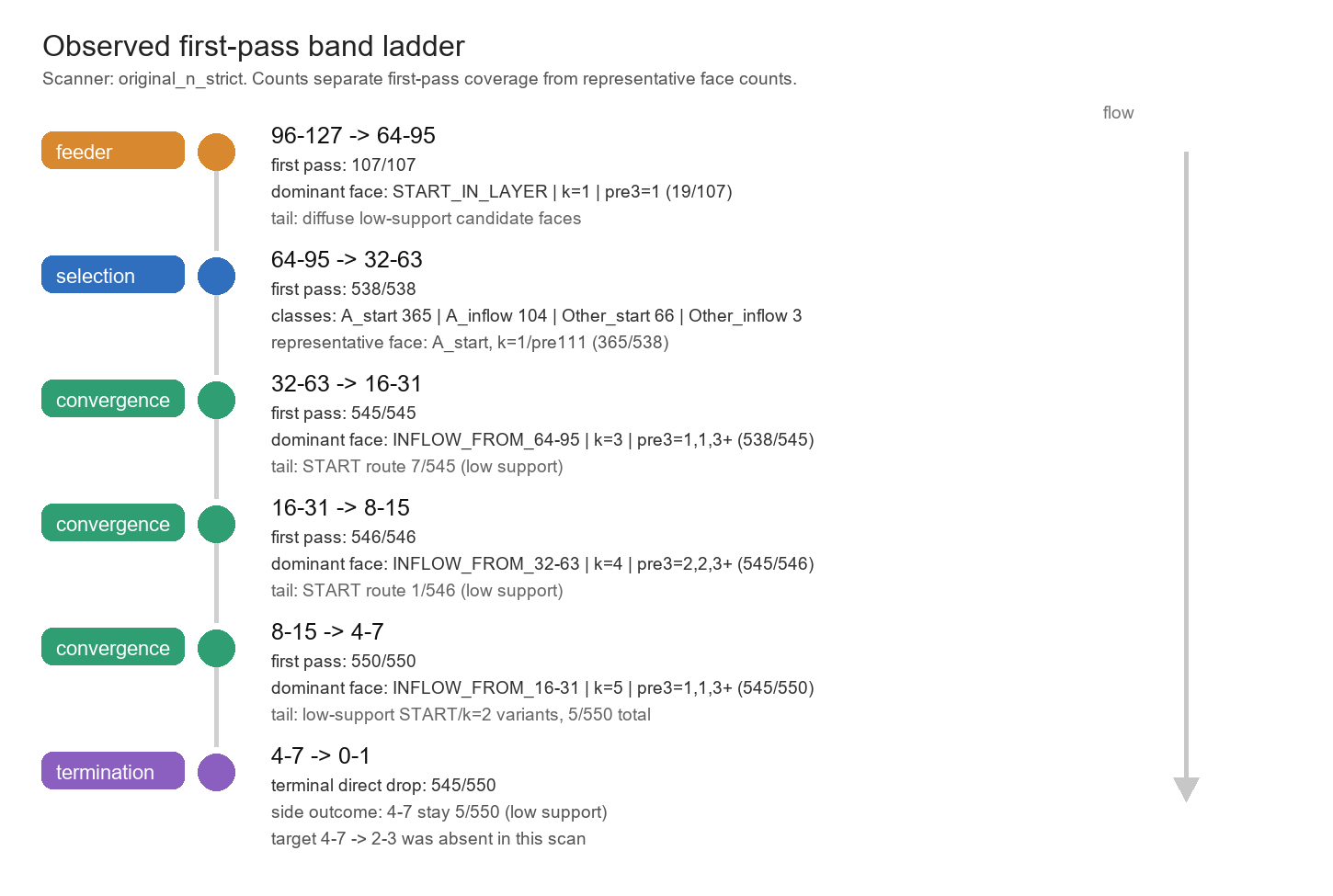
Main observation. First-pass coverage forms a band ladder from the upstream feeder through the 64-95 → 32-63 intersection row and then into downstream reconvergence.
Across the sampled universe, first-pass coverage organizes into an observed band ladder running from upstream to the terminal bins:
96-127 → 64-95 → 32-63 → 16-31 → 8-15 → 4-7 → 0-1Table 1 gives the per-boundary role, dominant compact face, and dominant share. Roles are observational labels for the patterns found: feeder describes a diffuse upstream surface; intersection row describes the boundary where multiple axes co-occur (R3–R4); merged downstream face / terminal drop describe rows that converge onto one dominant compact face.
| Boundary | Role | Dominant compact face | Dominant share | Face diversity (entropy) | Class separation |
|---|---|---|---|---|---|
96-127 → 64-95 | feeder | START_IN_LAYER | k=1 | pre3=1 | 0.178 | 4.069 | 8.000 |
64-95 → 32-63 | intersection row | START_IN_LAYER | k=1 | pre3=1,1,1 | 0.678 | 1.643 | 15.212 |
32-63 → 16-31 | reconvergence / merged downstream | INFLOW_FROM_64-95 | k=3 | pre3=1,1,3+ | 0.987 | 0.099 | 0.000 |
16-31 → 8-15 | merged downstream (cleanest) | INFLOW_FROM_32-63 | k=4 | pre3=2,2,3+ | 0.998 | 0.019 | 0.000 |
8-15 → 4-7 | merged downstream | INFLOW_FROM_16-31 | k=5 | pre3=1,1,3+ | 0.991 | 0.087 | 0.000 |
4-7 → 0-1 | terminal drop | INFLOW_FROM_8-15 | k=4 | pre3=1,3+,3+ | 0.991 | 0.075 | 0.000 |
Three observations follow directly from Table 1, stated descriptively:
- The feeder
96-127 → 64-95has the highest face diversity (entropy4.069) and the lowest dominant-face share (0.178) of any row — it is diffuse, not concentrated on one face. - The intersection row
64-95 → 32-63has the lowest face diversity of the upper boundaries (1.643) together with the highest class separation in the table (15.212) — i.e. relatively few faces, but those faces line up closely with class identity. R3-R4 develop this co-occurrence reading. - All three downstream merged rows and the terminal row have dominant shares ≥ 0.987 and class separation
0.000: previously separated classes are observed to converge onto a shared compact face after the pass (R2).
Observed first-pass band ladder
Shows, per boundary, first-pass coverage counts (e.g. 64-95 → 32-63: 538/538) separately from representative compact-face counts, plus low-support tails at each row (e.g. 32-63 → 16-31: 7/545 on the non-dominant side).
R2The 64-95 → 32-63 first-pass face and its classes
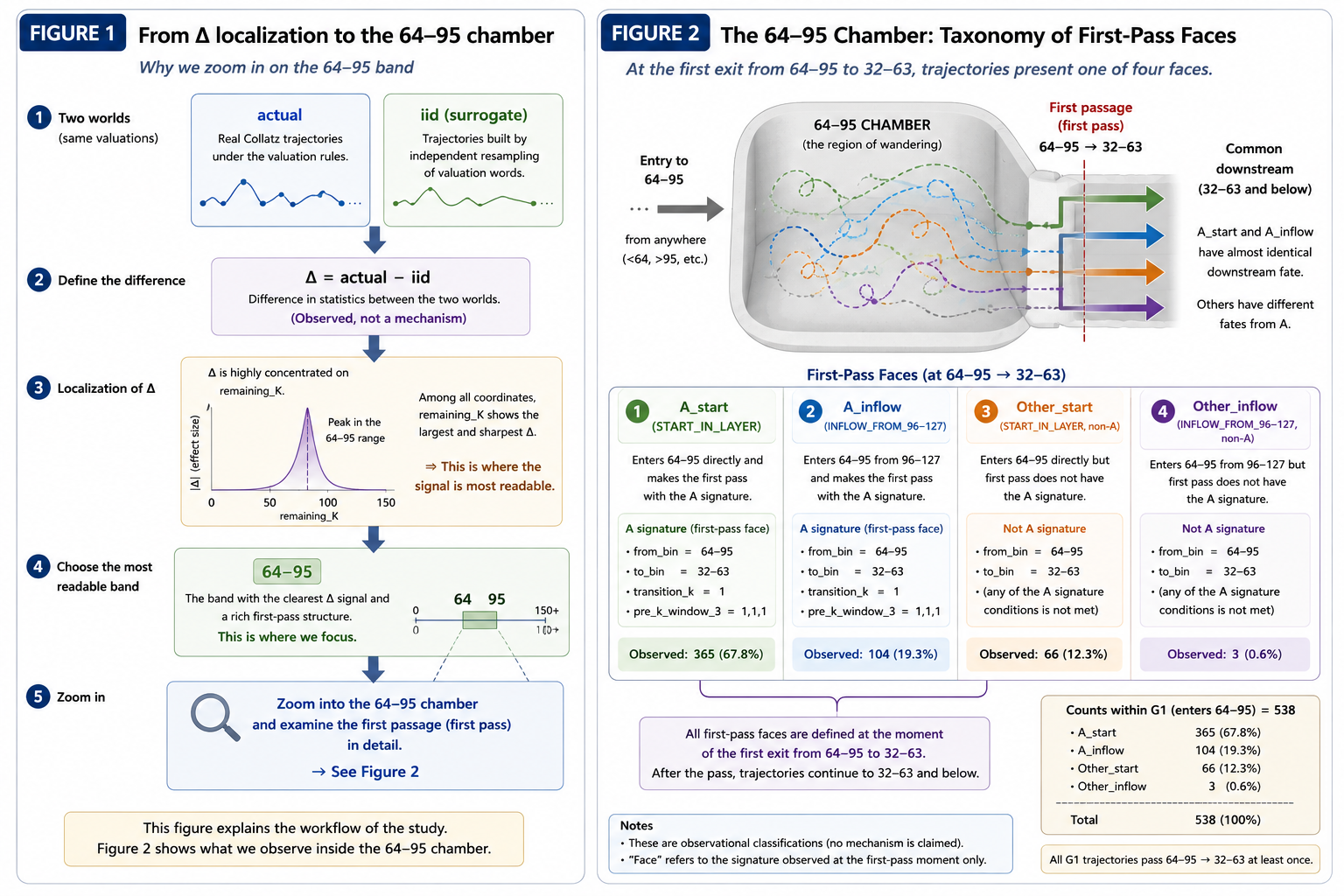
Main observation. The 64-95 → 32-63 first pass partitions the 538 entering trajectories into four classes, with the A face defined by route plus local all-1 pass context.
R2.1 Entry partition. Of the 550-trajectory universe, 12 trajectories never enter the 64-95 layer (G0); the remaining 538 do enter it (G1), and every G1 trajectory eventually performs a 64-95 → 32-63 pass.
R2.2 First pass vs. first entry. The first event inside the 64-95 layer is never an A face: it is a 64-95 → 64-95 stay, not a pass; no trajectory's first-entry event is an A face (R2.3). Among trajectories that ever satisfy the A face, it coincides with the first 64-95 → 32-63 pass in every observed case. The A face is therefore described as a within-layer first-pass face: it is defined at, and observed to coincide with, the first pass — never with first entry.
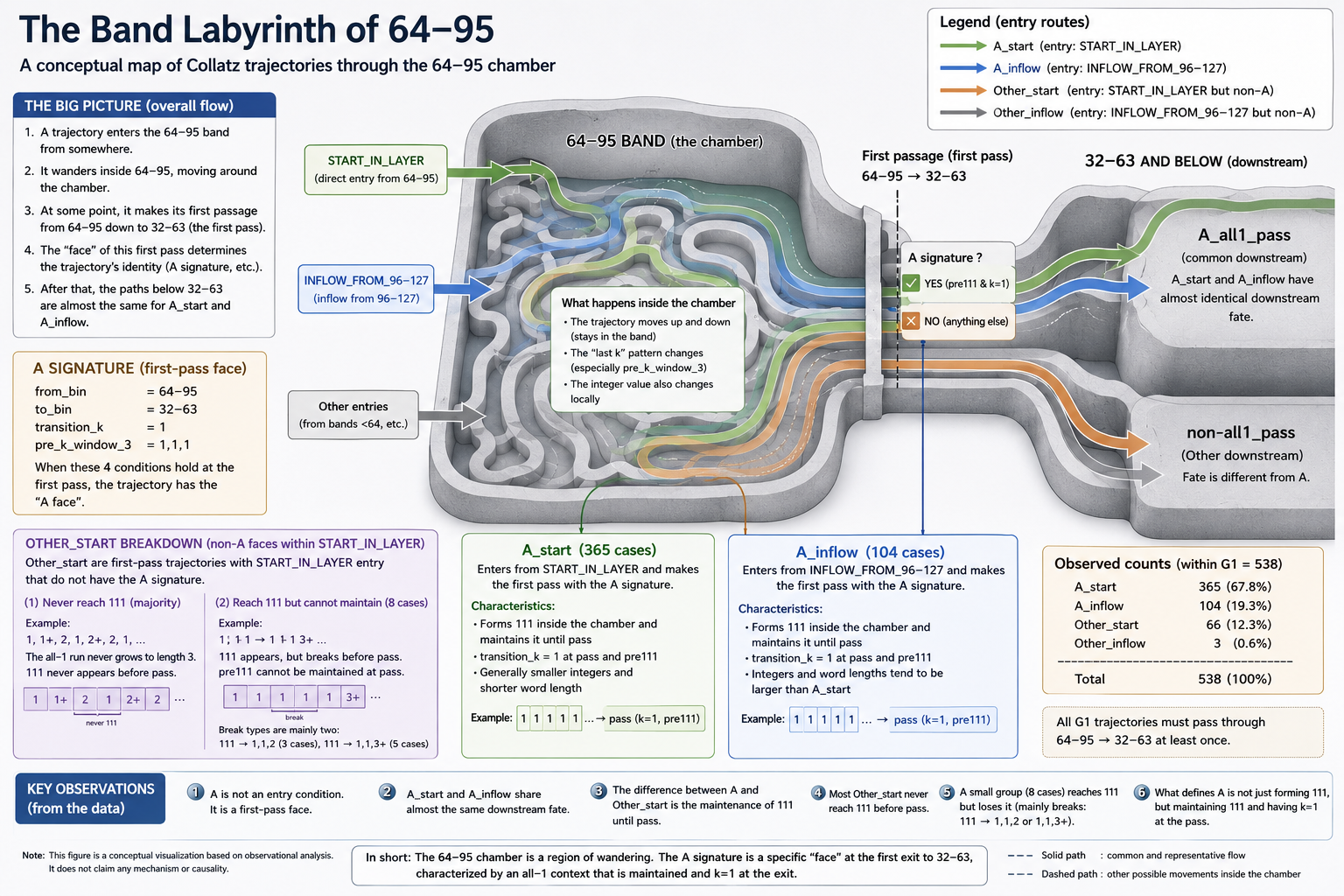
R2.3 Four-class partition of G1. Classifying each G1 trajectory by its first-pass descriptor gives four classes that partition the 538 trajectories (Table 2). The term A face (not "A signature") is used for the joint condition from = 64-95, to = 32-63, transition_k = 1, pre_k_window_3 = 1,1,1 (i.e. pass-face all-1, D8), observed under one of two entry
routes.
| Class | Count | Share of G1 | Entry route | First-pass face | Pass-face all-1 |
|---|---|---|---|---|---|
A_start | 365 | 0.678 | START_IN_LAYER | k=1, pre3=1,1,1 | 1.000 (by def.) |
A_inflow | 104 | 0.193 | INFLOW_FROM_96-127 | k=1, pre3=1,1,1 | 1.000 (by def.) |
Other_start | 66 | 0.123 | START_IN_LAYER | not A face | — |
Other_inflow | 3 | 0.006 | INFLOW_FROM_96-127 | not A face | — |
Checks: 365 + 104 + 66 + 3 = 538; 538 + 12 = 550.
A_start and A_inflow share the same local pass face (k=1,
pre3=1,1,1) and differ only by entry route. Other_start
and Other_inflow are the observed non-A complement at the same boundary, by route.
We do not describe any of Other_start/Other_inflow collectively as
"near-A failures"; within Other_start, the leading deformations keep START_IN_LAYER and often k=1 but break the all-1 pre-window (cf. Figure
2, "Other_start breakdown" panel).
R2.4 Shared downstream corridor. After the first pass, A_start and A_inflow are observed to follow a common coarse downstream path: their top next-3 and next-5 transition sequences are predominantly 32-63 → 32-63 stays, and the next boundary's dominant face is the same for both, INFLOW_FROM_64-95 | k=3 | pre3=1,1,3+ (cf. Table 1, row 3). These trajectories share a downstream corridor: an observed coarse-path similarity after the first pass.
Other_inflow = 3 is part of the G1 = 538 first-pass partition reported here and in the forensic summary (Table 6). It is, by contrast, excluded from the three-class all-1 formation table (all1_formation_class_summary.csv, R5) by scope, because it is a low-support cell (3 trajectories). This is an intentional scoping choice in that table, not a count discrepancy: 365 + 104 + 66 = 535 rows are tabulated there against the 538 in G1.
64-95 chamber / first-pass face taxonomy
The panels show: (i) entry of A_start/A_inflow/Other_start/Other_inflow into the 64-95 chamber by route; (ii) the first-pass decision point; (iii) the Other_start breakdown into "never reaches 111" vs. "reaches 111 but cannot maintain it" (the natural home for the lost-111 micro-cases referenced in R5); (iv) the observed counts table (365/104/66/3, 538 total).
R3Boundary differential comparison
Main observation. The intersection row is distinguished by a combination of route split, all-1 pass-face context, and class separation, not by maximal neighbor distance alone.
R3.1 Not a maximal-neighbor-distance claim. The intersection row (64-95 → 32-63) is not singled out by raw neighbor distance. The summed descriptive distance around it is 4.676, which is below the downstream-neighbor average of 5.996 (Table 3, where it is listed under its internal analysis label B_sort). Downstream boundaries show large raw label changes for an uninteresting reason: transition_k, pre3, and entry_route are boundary-specific labels, so neighboring boundaries differ in their labels almost by construction.
"64-95 → 32-63" is not identified here as special by maximal neighbor distance alone.
R3.2 What does single it out: a combination. What distinguishes the intersection row (64-95 → 32-63) is the combination of moderate face diversity (1.643, Table 1) with high class separation specifically among the four first-pass classes. Table 4 decomposes the class-distance total (15.212) at this boundary by class pair: A_start vs A_inflow contributes 4.000 (driven by compact_face_l1 and entry_route_l1, since the two classes differ only by route); A_start vs Other_start contributes 4.606; A_inflow vs Other_start contributes 6.606 (the largest single pair, combining a route difference with the all-1/non-all-1 split). At the upstream feeder (96-127 → 64-95), the same class-pair decomposition sums to only 8.000 overall, and is driven almost entirely by the A_inflow vs. others contrast (A_start vs. Other_start is 0.000 there); downstream of 64-95 → 32-63, all class-pair distances are 0.000 (Table 1).
Its distinctive role is the co-occurrence of route split, local all-1/pass-face context, and class separation.
R3.3 Feature-association screen. A descriptive feature screen over the 64-95 → 32-63 occurrence table (internally, the "sorting-power" screen over boundary B_sort) finds that the feature most strongly associated with class identity is full_face, with a mutual-information-like association score of 1.251 and purity 1.000. We read this as: the full joint first-pass descriptor aligns with class membership almost exactly, which is close to a restatement of how the classes were defined (R2.3) rather than a new discovery. This reflects the class definitions rather than an additional observation.
R3.4 Other boundary-level extremes. The most diffuse boundary by face-diversity is the feeder 96-127 → 64-95 (entropy 4.069, 24 compact faces); the cleanest merged boundary is 16-31 → 8-15 (dominant share 0.998). The upstream feeder supplies the route label (START_IN_LAYER vs. INFLOW_FROM_96-127) used at 64-95 → 32-63, but it does not by itself uniquely identify the later A_inflow class; the A/non-A separation is carried at the 64-95 → 32-63 face itself (cf. Table 4, where the upstream feeder's A_start-vs-Other_start distance is 0.000).
| Quantity | Value |
|---|---|
Summed descriptive distance, 64-95 → 32-63 neighbors (internal label B_sort) | 4.676 |
| Downstream-neighbor average descriptive distance | 5.996 |
Class-distance total at 64-95 → 32-63 (B_sort) | 15.212 |
Class-distance total at upstream feeder 96-127 → 64-95 (B_up) | 8.000 |
| Class-distance total, all downstream rows | 0.000 |
| Boundary | Class pair | compact_face_l1 | transition_k_l1 | pre3_l1 | entry_route_l1 | Row total |
|---|---|---|---|---|---|---|
B_sort | A_start vs A_inflow | 2.0 | 0.0 | 0.0 | 2.0 | 4.000 |
B_sort | A_start vs Other_start | 2.0 | 0.606 | 2.0 | 0.0 | 4.606 |
B_sort | A_inflow vs Other_start | 2.0 | 0.606 | 2.0 | 2.0 | 6.606 |
B_up | A_start vs A_inflow | 1.0 | 1.0 | 1.0 | 1.0 | 4.000 |
B_up | A_start vs Other_start | 0.0 | 0.0 | 0.0 | 0.0 | 0.000 |
B_up | A_inflow vs Other_start | 1.0 | 1.0 | 1.0 | 1.0 | 4.000 |
Boundary differential comparison
A small-multiple or bar-chart rendering of Table 3 and Table 4: (i) the 64-95 → 32-63 boundary vs. downstream-average neighbor distance, visually showing 4.676 < 5.996; (ii) class-distance total by boundary, with 64-95 → 32-63 (15.212) the clear maximum and downstream rows flat at 0.000.
B_sort / "sorting-power" labels are reported as descriptive analysis labels only.R4Boundary intersection map
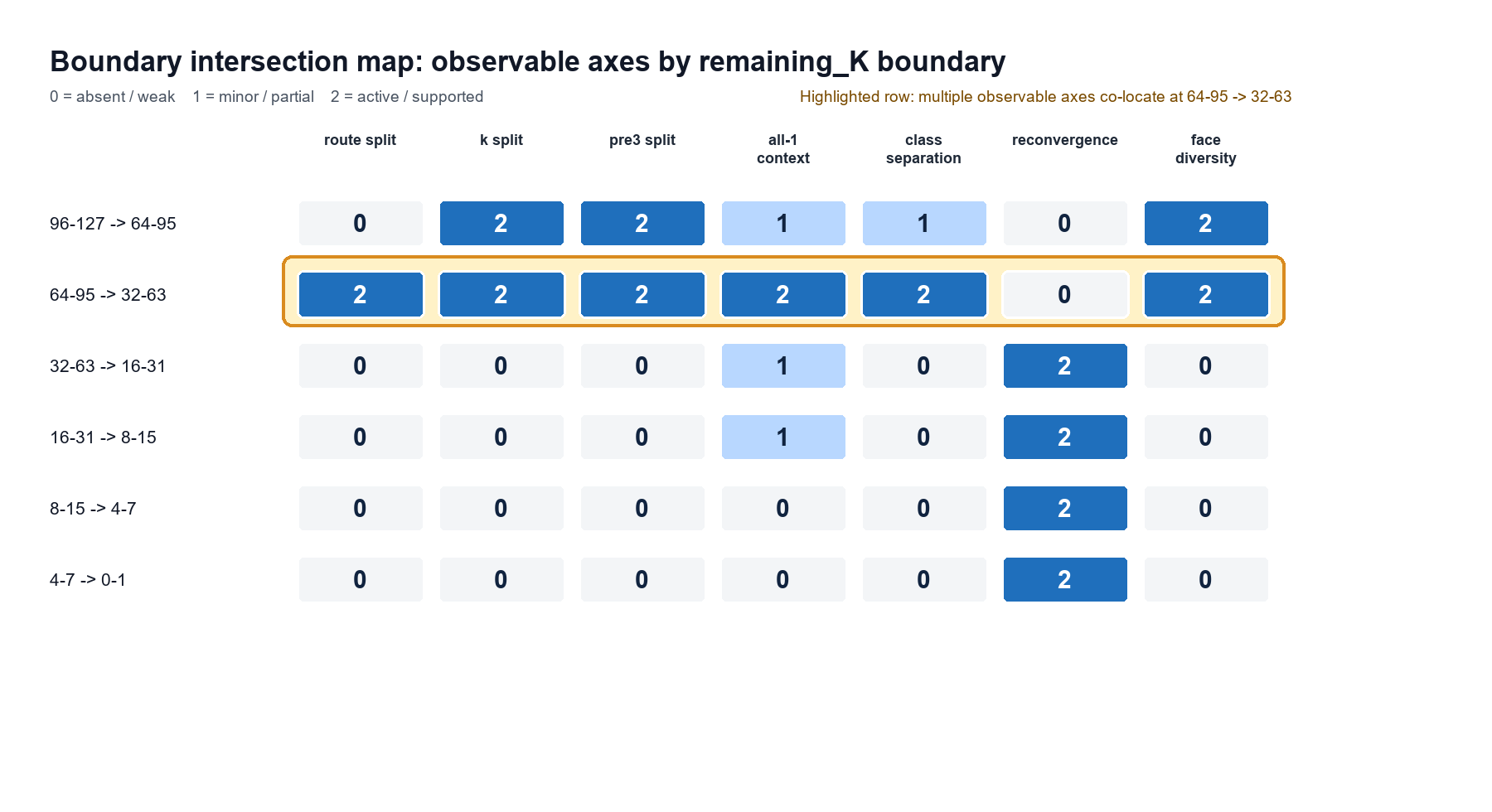
Main observation. The 64-95 → 32-63 row is the only boundary where all six displayed observable axes are active in this scan.
R4.1 Thresholds. The intersection map evaluates six observable axes (route split, k split, pre3 split, all-1 context, class separation, face diversity) per boundary on a 0/1/2 scale: distribution axes use 0 if the dominant value's share is ≥ 0.98, 1 if only one non-dominant value has support ≥ 10, 2 if multiple values have support ≥ 10; class separation is 2 for the 64-95 row or total class-distance ≥ 8, 1 for nonzero but weaker separation; reconvergence is 2 on downstream rows where major classes share the dominant compact face; face diversity is 2 when compact-face entropy ≥ 2 or ≥ 20 compact faces are present.
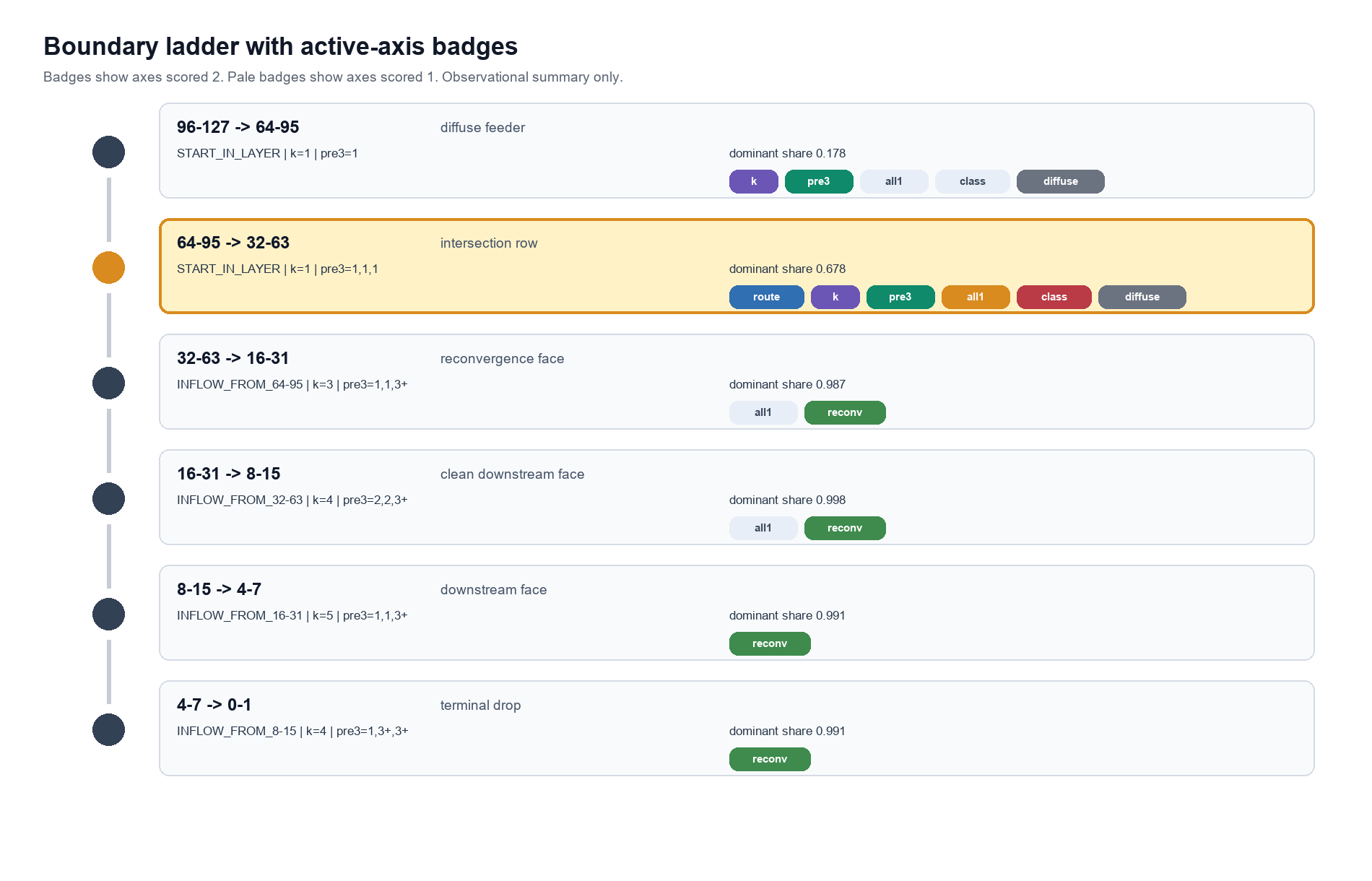
R4.2 Result. 64-95 → 32-63 has the strongest intersection of active axes in the table: active-axis count 6 and total score 12 — the only row that scores on all of route split, k split, pre3 split, all-1 context, class separation, and face diversity simultaneously (Table 5; Figure 4). Downstream rows score mainly, and in several cases solely, on reconvergence. The upstream feeder 96-127 → 64-95 is diffuse (high face diversity) but scores only 3/8 overall, and is explicitly weak as a standalone separator of the later A/non-A classes (cf. R3.4, Table 4).
This is an observational intersection map for the present scan.
| Boundary | Role | Active axes (score 2) | Active-axis count | Total score | Dominant face |
|---|---|---|---|---|---|
96-127 → 64-95 | diffuse feeder | k split, pre3 split, face diversity | 3 | 8 | START_IN_LAYER | k=1 | pre3=1 |
64-95 → 32-63 | intersection row | route split, k split, pre3 split, all-1 context, class separation, face diversity | 6 | 12 | START_IN_LAYER | k=1 | pre3=1,1,1 |
32-63 → 16-31 | reconvergence face | reconvergence | 1 | 3 | INFLOW_FROM_64-95 | k=3 | pre3=1,1,3+ |
16-31 → 8-15 | clean downstream face | reconvergence | 1 | 3 | INFLOW_FROM_32-63 | k=4 | pre3=2,2,3+ |
8-15 → 4-7 | downstream face | reconvergence | 1 | 2 | INFLOW_FROM_16-31 | k=5 | pre3=1,1,3+ |
4-7 → 0-1 | terminal drop | reconvergence | 1 | 2 | INFLOW_FROM_8-15 | k=4 | pre3=1,3+,3+ |
Boundary intersection heatmap
Axis grid (rows = boundaries, columns = the six observable axes), 64-95 → 32-63 row highlighted as the only full-intensity row.
Boundary intersection ladder
The band ladder of Figure 1, re-annotated with active-axis badges per boundary; 64-95 → 32-63 shown with all six badges active.
R5All-1 formation, pass-face all-1, and continuous maintenance
Main observation. Pass-face all-1, continuous pre111 maintenance, and 1111 present at pass are distinct quantities and have different observed values.
R5.1 Pass-face all-1 is true by definition. For A_start and A_inflow, pass-face all-1 (D8) is 1.000 because it is how the classes are defined: the first pass is k=1, pre3=1,1,1. This is a pass-event quantity (D8) and is distinct from Table 6's "pre111 ever appears before pass" column, which instead reports whether pre111 is reached anywhere in the entry-to-pass window, not necessarily at the pass itself (Table 6 below; source field share_first_pre111_present).
R5.2 Continuous pre111 maintenance is strictly lower. Once pre111 first appears within the entry-to-pass window, whether it is held at every subsequent event through the pass is a different and strictly harder condition. The observed shares are A_start = 0.729, A_inflow = 0.548, Other_start = 0.000, Other_inflow = 0.000 (Table 6). This does not contradict R5.1. It is a different, stricter, temporal quantity, and the two are not reported as the same number.
R5.3 Break statistics. Where continuous maintenance fails for A_start/A_inflow, the interrupting break is one of two kinds: pre3 goes to 1,1,2 or to 1,1,3+. For A_start: 1,1,2 in 59 cases (0.596 of breaks), 1,1,3+ in 40 (0.404). For A_inflow: 1,1,2 in 29 (0.617), 1,1,3+ in 18 (0.383). In both classes, the same final step is the one perturbed; the run interrupts rather than collapses.
R5.4 Formation timing. Across the all-1 formation analysis (all1_formation_class_summary.csv), the median distance from the first appearance of 111 to the pass is 1 event for both A_start and A_inflow — that is, the first 111 often appears close to the pass, rather than early in the entry-to-pass window.
R5.5 1111 present at pass is a separate, third quantity. The class-summary column share_maintaining_1111_until_pass reports A_start = 0.564, A_inflow = 0.548. Despite its column name, this is a pass-presence judgment — whether the length-4 run 1111 is present at the pass — directly analogous to R5.1 but one digit longer, and is not a continuous/strict maintenance measure (D10). It is therefore reported as "1111 present at pass" or "pass-event 1111," not as "strict" or "continuous" maintenance, and it is kept visually and verbally distinct from R5.2's 0.729/0.548.
R5.6 Where the separator lives. Among START_IN_LAYER rows, Other_start mostly never reaches 111 before the pass at all (share with pre111 ever appearing before pass = 0.121, Table 6) — only a small subset (8 of 66) reach it and then lose it (the lost-111 micro-cases; cf. Figure 2's "Other_start breakdown" panel). The observational reading is therefore: the separator between A_start and same-route Other_start lives at the pass, in the local all-1 context, not in some earlier formation event.
Other_inflow = 3; the all-1 formation class summary tabulates only the three larger classes (A_start, A_inflow, Other_start), excluding Other_inflow by scope (low support), not because of any count discrepancy.| Class | Count | Median wait (events) | Pass-face all-1 (by def.) | pre111 ever appears before pass | Continuous pre111 maintenance | 1111 present at pass | Dominant pass face |
|---|---|---|---|---|---|---|---|
A_start | 365 | 10.0 | 1.000 | 1.000 | 0.729 | 0.564 | START_IN_LAYER | k=1 | pre3=1,1,1 (1.000) |
A_inflow | 104 | 17.0 | 1.000 | 1.000 | 0.548 | 0.548 | INFLOW_FROM_96-127 | k=1 | pre3=1,1,1 (1.000) |
Other_start | 66 | 3.0 | — | 0.121 | 0.000 | — (not A face) | heterogeneous; leading k=1 | pre3=3+,1,1 (0.424) |
Other_inflow | 3 | 17.0 | — | 1.000 | 0.000 | not tabulated (out of scope, R5.7) | low support |
pre111 is reached anywhere in the entry-to-pass window, not whether it is present at the pass; it is a different quantity from "pass-face all-1" (D8) and from "1111 present at pass" (D10). Other_inflow's share of 1.000 on this column means pre111 was reached at some point before the pass for all 3 rows — it does not imply that Other_inflow satisfies the A face or has pre111 at the pass itself; by definition, Other_inflow is precisely the non-A complement at this boundary (Table 2), and its continuous-maintenance share is 0.000 regardless.Pass-face all-1 vs. continuous maintenance
Other_start and Other_inflow are not drawn as zero-height bars on the pass-face-all-1 axis, because the quantity is undefined for non-A classes rather than measured as zero. They are marked "not A face / n/a". Their continuous-pre111-maintenance values, both 0.000, are measured values and are shown as bars on the right panel.1111-present-at-pass column is not described as strict or continuous maintenance, and the lower continuous-maintenance shares are not interpreted against the pass-face classification.
R6Miss-event local type vs. pre-exit waiting behavior (key-safe join audit)
Main observation. A key-safe join links miss-event local types to pre-exit waiting behavior for all 228 miss rows at exact event-position equality, where the waiting behavior is uniformly no_exit_layer_observed. A separate drift_down overlap of 69 rows is a weak trajectory-band candidate, not a direct event-level join, and the two are not mixed.
This result adds a key-safe join audit between miss-event local types and pre-exit waiting behavior. It is an event-position-key audit, kept structurally separate from the first-pass face results above. As elsewhere in this note, it reports where keys match and where descriptors co-locate. Two link types are reported and are never mixed: a strong event-level join (exact event-position equality) and a weak trajectory-band candidate overlap (trajectory/band coexistence only).
R6.1 No native event-position key in the miss file. miss_local_type_final_detail.csv carries miss values and band_jump, but on inspection it has no event-position column of its own. A direct event-level join therefore could not be performed from that file as-is.
R6.2 Event index recovered for all rows. miss_event_index was recovered for 228 of 228 miss rows from miss_event_detail.csv. In the source script this recovered index is first_pass_index-derived (miss_event_index = int(row['first_pass_index']) in miss_event_local_state_audit.py), so it is an event-row position rather than a separately named odd-step counter.
R6.3 Strong event-level join reaches the waiting layer for 228/228. Using the composite key sample_id + trajectory_id + miss_before_band/band_label + miss_event_index/first_pass_index, the miss rows join to the waiting side at exact event-position equality for 228 of 228 rows. Under this strong join, the observed waiting behavior is no_exit_layer_observed for all 228 rows.
The strong event-level join uses exact event-position equality and reports key overlap and descriptive counts only within the present dataset.
R6.4 The drift_down overlap is a weak candidate, not a direct join.
Separately, miss_after_band → drift_down shows 69 overlap rows. These are a weak trajectory-band candidate overlap, selected on sample_id + trajectory_id + target_band_from_band_jump (the right-hand side of band_jump), and they are not a direct event-level join. They can show that a miss-event trajectory and a waiting-hall band record coexist under compatible trajectory/band keys; they cannot show that the miss event occurred at the same event position as a waiting-hall phase boundary. The 69 candidate rows and the 228 no_exit_layer_observed event-join rows are kept separate and are not merged.
The 69 drift_down rows are a candidate overlap, not a direct event-level join, and are not merged with the 228/228 strong join.
| Miss local type | Count in 69 candidate overlap | Candidate rate within type |
|---|---|---|
A | 13 | 20.31% (13/64) |
B | 28 | 32.94% (28/85) |
C1 | 0 | 0.00% (0/13) |
C2 | 0 | 0.00% (0/10) |
C3 | 6 | 100.00% (6/6) |
C_unassigned | 22 | 44.00% (22/50) |
Check: 13 + 28 + 0 + 0 + 6 + 22 = 69. These are candidate-overlap counts only;
C1 and C2 contribute no rows to the 69.
R6.5 C3 is fully inside the candidate overlap, but n is small. All 6 of the 6 C3 rows fall in the drift_down candidate overlap (6/6, a within-type candidate rate of 100.00%). This is visually striking next to C1 and C2 (both 0), but C3 is an n = 6 cell, so it is treated here as candidate structure, not a load-bearing claim; a within-type rate near 100% on six rows should not be read as more than that small sample supports. The six C3 rows share a common descriptive profile (Table 8). The consistency of that profile across all six rows is consistent with their joint appearance in the candidate overlap, but at n = 6 we do not claim it generalizes.
| Feature | Value (all 6 rows) |
|---|---|
miss_before_band | 64-127 |
miss_after_band | 32-63 |
band_jump | 64-127 → 32-63 |
miss_before_value → miss_after_value | 70 → 63 (remaining_K coordinate; see R6.6) |
residue_pair_mod16 | 6 → 15 |
remaining_K parity | EO |
| expanded parity | OEEEEEEEO |
| next captured exit layer | 32-34 in 32-63 |
R6.6 70 → 63 is a remaining_K transition, not a Collatz
one-step. The 70 → 63 seen in the C3 rows is not an ordinary Collatz step on an integer value. It is also not an actual trajectory value, a band representative value, a normalized value, or an odd-only integer value. It is a remaining_K_before → remaining_K_after transition: the event consumes transition_k = 7, so 70 − 7 = 63 in remaining-K coordinates.
As a plain Collatz check, 70 is even, so one even step gives 70/2 = 35, not 63; the 70 → 63 step does not arise from a single odd/even rule application. The actual integer-side accelerated step at these events is a separate quantity — for example (3·6869 + 1) / 2⁷ = 161 on one C3 row, and (3·171989 + 1) / 2⁷ = 4031 on others — and must not be conflated with the 70 → 63 remaining-K coordinates.
228/228 strong event-level join and the 69 drift_down weak candidate overlap are reported as separate quantities and are not combined. The C3 = 6/6 cell carries its n = 6 caveat, and 70 → 63 is a remaining_K transition. The audit reports key overlap and descriptive counts only; it remains a descriptive key-overlap audit within the present dataset.04 — ReferenceTerminology table
| Canonical term | Definition | Value(s) | Terminology note |
|---|---|---|---|
pass-face all-1 (= "all-1 at pass") | First 64-95 → 32-63 pass has transition_k=1, pre_k_window_3=1,1,1. | A_start 1.000; A_inflow 1.000 (both by definition) | calling this "maintenance" |
continuous pre111 maintenance | After pre111 first appears, pre_k_window_3 stays 1,1,1 at every event through the pass. | A_start 0.729; A_inflow 0.548; Other_start/Other_inflow 0.000 | reporting this as 1.000 |
1111 present at pass (= "pass-event 1111") | Whether 1111 is present at the pass event. | A_start 0.564; A_inflow 0.548 | calling this "strict" or "continuous" maintenance |
pre111 ever appears before pass (share_first_pre111_present) | Whether pre111 is reached anywhere in the entry-to-pass window (formation, not pass-event presence). | A_start 1.000; A_inflow 1.000; Other_start 0.121; Other_inflow 1.000 | calling this "pre111 present at pass"; reading Other_inflow's 1.000 here as A-face membership |
A face (legacy: "A signature") | First-pass descriptor: from=64-95, to=32-63, transition_k=1, pre3=1,1,1, either entry route. | — | using "signature" as a mechanism |
A_start / A_inflow | A face with route START_IN_LAYER / INFLOW_FROM_96-127. | 365 / 104 | "relabelled A_start" for A_inflow |
Other_start / Other_inflow | Non-A first pass at the same boundary, by route. | 66 / 3 (low support) | "near-A failure" applied to all rows |
START_IN_LAYER | The valuation word begins in that remaining_K layer. | — | "first occurrence / first visit / first entry" |
first pass | First 64-95 → 32-63 pass event. | — | conflating with "first entry" |
co-occurrence | Multiple observable axes scoring high on the same boundary row. | 64-95 → 32-63: 6 axes, score 12 | "cause," "imposes downstream fate" |
reconvergence | Downstream rows where major classes share the dominant compact face. | shares ≈ 0.987–0.998 | "sorting mechanism" |
low-support tail | Cells below the support threshold; candidate structure only. | e.g. Other_inflow, START-route downstream tails | "result" |
strong event-level join (R6) | Link at exact event-position equality using sample_id + trajectory_id + miss_before_band/band_label + miss_event_index/first_pass_index. | 228/228; waiting behavior no_exit_layer_observed | calling the drift_down candidate overlap a "direct" link |
weak candidate overlap (R6) | Trajectory-band coexistence on sample_id + trajectory_id + target_band_from_band_jump; not an event-position match. | 69 drift_down rows | calling it an event-level join; merging it with the 228/228 join |
remaining_K transition 70 → 63 (R6) | remaining_K_before → remaining_K_after after consuming transition_k = 7; 70 − 7 = 63. | C3 rows (n = 6) | reading it as a Collatz one-step or as an actual/band/normalized integer value |
05 — Boundaries of the claimLimitations
Scope and sampling. The analysis universe is a sampled, scanner-defined ensemble
of 550 accelerated Collatz trajectories under original_n_strict, not an exhaustive
enumeration of integers. All shares, counts, and distances reported here are within-sample
quantities tied to that scanner mode; a different mode (e.g. odd_core,
odd_only) would shift counts, though we do not re-derive that dependence in this note.
Descriptive scope. Every claim in this note is a concentration, co-occurrence, separation, or reconvergence statement about observed descriptors within the analyzed dataset. The boundary intersection map (R4) marks where multiple descriptors co-occur in this scan.
Low-support tails. Several cells remain visible in the tables above but are explicitly not load-bearing: Other_inflow (3 of 538), the small START-route tails on downstream boundaries (e.g. 7/545 at 32-63 → 16-31), and the lost-111 micro-cases within Other_start (8 of 66). These are candidate structure, not claims.
Open descriptive questions. This note does not explain why descriptors are distributed the way Tables 1, 4, and 5 show; why low-support tails appear where they do; or whether the same contrasts would persist under a larger or differently sampled universe. These are left open.
06 — ContextRelation to other chapters
This note is part of a larger Collatz-trajectory research program that also includes a broad actual-vs-iid finite-block discrepancy analysis and a separate localization/diagnostic ("delta") analysis identifying where on the remaining_K axis an actual-vs-surrogate difference signal concentrates.
Both of those analyses exist as their own chapters and are not reproduced or re-derived here; they are used only to motivate the present zoom-in (the delta analysis is what originally pointed at the 64-95 band as the most readable region). This note takes that localization as a starting point and asks a narrower, purely descriptive question about first-pass structure within and around the 64-95 → 32-63 boundary.
No claim from the finite-block or delta chapters is imported into this note, and no claim made here is asserted to hold for those chapters. A later piece of work may connect the three — for instance, asking whether the 64-95 → 32-63 intersection-row pattern found here is itself a finer-grained view of the difference signal the delta chapter localizes to the 64-95 band — but that connection is not attempted here, and no claim in this note should be read as already making it.
07 — TraceabilityEvidence files
All numbers in this note are traceable to the following files. Re-deriving or spot-checking any number in Tables 1–6 should start here.
| File | Used for |
|---|---|
boundary_differential_report.md | Table 1 (compact boundary table); R3.1–R3.4 (neighbor contrast, sorting-power screen, forensic reading) |
boundary_intersection_map_report.md | R4.1–R4.2 (thresholds, scope statement) |
boundary_intersection_table.md | Table 5 (active axes, dominant face, reading column) |
| File | Used for |
|---|---|
boundary_diff_step6_64_95_forensic_summary.csv | Table 6 — count, median_wait, share_first_pre111_present, share_maintains_pre111_to_pass |
boundary_diff_step5_class_distance_by_boundary.csv | Table 4 — class-pair decomposition of class distance at B_sort / B_up |
boundary_intersection_axis_scores.csv | Table 5 — active_axis_count, axis_score_total, dominant_face, dominant_share |
all1_formation_class_summary.csv | Table 6 — share_maintaining_1111_until_pass, median_distance_first_111_to_pass (three-class scope; see R2.5/R5.7) |
| File | Used for |
|---|---|
miss_wait_join_report.md | R6.4, Table 7 (candidate-overlap summary; 69 vs 159 split) |
miss_wait_join_limitations.md | R6.1, R6.4 (no native event-position key; candidate-vs-join scope guardrails) |
miss_event_position_key_report.md | R6.2–R6.3 (228/228 miss_event_index recovery; first_pass_index provenance; key-safe join) |
drift_down_candidate_report.md | Table 7 (drift_down candidate overlap by miss type; in/out comparison) |
drift_down_candidate_examples.md | R6.4–R6.5 (per-type candidate-overlap example rows) |
c3_candidate_examples.md | R6.5, Table 8 (common C3 profile; C3 vs C1/C2) |
c3_70_63_semantics_audit.md | R6.6 (what 70 → 63 means: remaining_K transition, not a Collatz one-step) |
revised_layered_pathway_map_v2_report.md | R6 overall (strong-join vs weak-candidate separation) |
revised_map_legend_v2.md | R6 overall (map legend: solid strong join vs dashed weak candidate) |
| File | Used for |
|---|---|
c3_70_63_trace.csv | R6.6 (per-row ±3 event window; remaining-K vs integer-side comparison) |
c3_70_63_source_columns.csv | R6.6 (source-column provenance for the 70 → 63 values) |
revised_relationship_matrix_v2.csv | R6 map figure backing data |
revised_layered_pathway_map_v2.png | R6 map figure (solid strong join vs dashed weak candidate) |

| File | Used for |
|---|---|
updated_band_ladder_summary.png | Figure 1 |
boundary_intersection_heatmap.png | Figure 4 |
boundary_intersection_ladder.png | Figure 5 |
"Band Labyrinth of 64-95" conceptual figure | Source figure for Figure 2; final terminology follows the A face convention used in this paper. |
"From Δ-localization to the 64-95 chamber" / "Taxonomy of First-Pass Faces" conceptual figure | Source figure for Figure 2; final terminology follows the A face convention used in this paper. |
| Script | Used for |
|---|---|
python/ | Script directory for regenerating the CSV, report, and figure artifacts listed above. |
boundary_differential_analysis.py | Builds the boundary differential summaries and class-distance outputs used in R1 and R3. |
build_boundary_intersection_map.py | Builds the boundary intersection map, active-axis scores, and related Figure 4 / Figure 5 artifacts. |
build_band_ladder_summary.py | Builds the observed first-pass band ladder summary used for Figure 1. |
analyze_all1_context_formation.py | Generates the all-1 formation and maintenance summaries used in R5 and Table 6. |
paradoxical_sequence_analysis.py | Primary paradoxical-sequence scan and source for the remaining_K transition evidence. |
paradoxical_64_95_deep_dive.py | Deep-dive analysis for the 64-95 → 32-63 boundary and first-pass face classes. |
rebuild_paradoxical_sequence_report.py | Regenerates the reader-facing reports from the analysis outputs. |
Reference-only (old drafts, audited but not carried forward directly):
Companion planning documents (not evidence, but the source of this note's structure and terminology decisions):